Tuesday, March 5, 2013

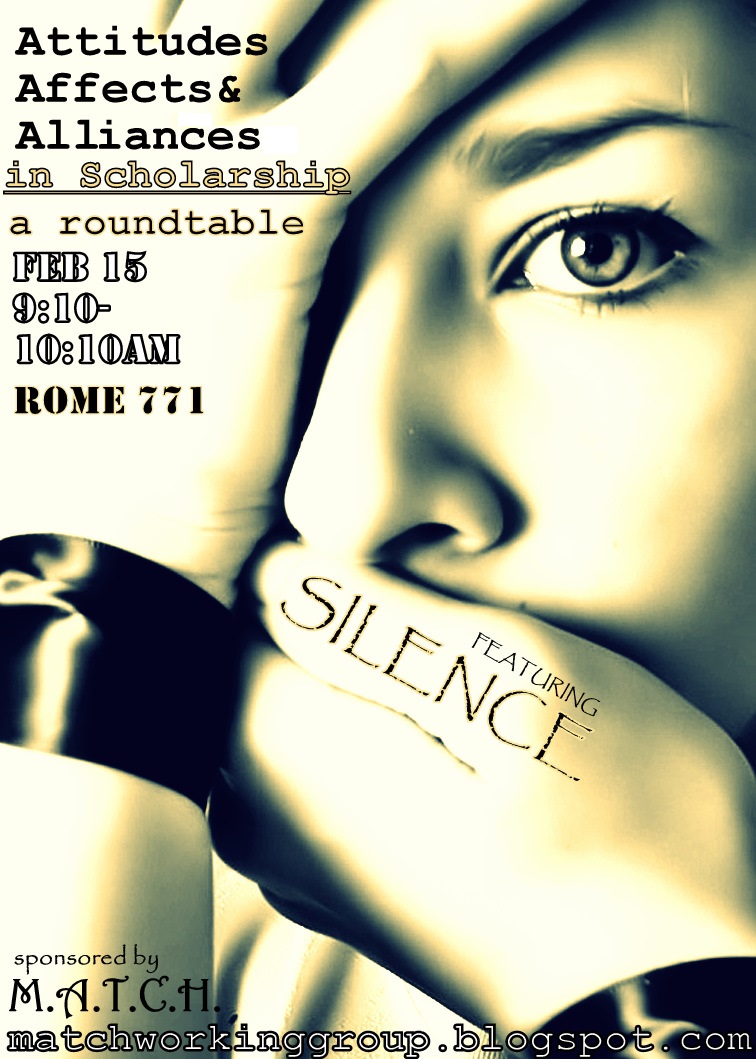
Attitudes, Affects & Alliances in Scholarship (Part 3): Silence

SILENCE


Sukshma Vedere

***************(...)*************

Silence is my zone of comfort. Having grown up in a conservative family, where talking to the opposite sex made elders shake their heads in disapproval, going to parties was denied with a firm “NO”, and watching the television was considered “a waste of time”, I grew up to be an anti-social geek with books as friends and silence as companion. 

I hated drawing attention and always preferred to remain in the background of any social events/gathering. I loved to be unnoticed! The back bench in class was always mine, from where I tried to evade the teacher’s questioning eyes. Maintaining distance from people made me feel secure. Few ever knew what was on my mind, I was either considered mysterious or dull by peers.

***************(...)*************

However, from the moment that I decided that I wanted to focus on academics and saw the need to acquire teaching skills to improve my chances of employment, my silent bubble burst. It took me a lot of effort to face the classroom, becoming the object of attention as a teacher. 

I often wondered why academics was always associated with rhetoric and wished it had been otherwise. Why is vocal language the normative means of communication? Can’t people communicate in silence? -were some of the questions which intrigued me at that time. Some of my friends used to joke saying that I ought to become a teacher for the vocally challenged/dumb/muted.

In retrospect, I find it ironical that I have gained proficiency in several languages/ means of communication and prefer silence to rhetoric. I believe that meaning is fluid in a space of silence and that orality shatters the “subjunctive possibilities” of meaning by making things explicit. Speech is a selective device that overlooks subtle experiences to highlight a dominant experience and validate it as reality.

***************(...)*************

In silence, my identity is fluid, no one knows me or judges me, not even myself. I like it that way. 

In The History of Sexuality Foucault explains:

"Silence itself—the things one declines to say, or is forbidden to name, the discretion that is required between different speakers—is less the absolute limit of discourse, the other side from which it is separated by a strict boundary, than an element that functions alongside the things said, with them and in relation to them within over-all strategies.... There is not one but many silences, and they are an integral part of the strategies that underlie and permeate discourses."

In my research, I am interested in discourses of silence, and unhistorical narratives which reveal experiences which have gone unrecorded in the span of history. It is time to take a look at how silences shape reality and construct experiences, how silences contain fluid identities and affects which get trapped in the rhetoric of language when made explicit. 


***************(...)*************

Listen via Podcast to
the M.A.T.C.H. Round-Table 
"Attitudes, Affects & Alliances 
in Scholarship"
15 February 2013


Thursday, February 21, 2013

Attitudes, Affects & Alliances in Scholarship (Part 2): Dragon

DRAGON


Leigha McReynolds

************ /// *************

Like everyone else in an English PhD program, I love to read. The books that really grabbed me when I was young, not just that I enjoyed and re-read but that spoke to me as something more, were about girls with dragons, specifically Anne McCaffrey’s Dragonsinger trilogy and Tanith Lee’s Biting the Sun. 

Likewise, while I decided at about age 15 that I was going to be an English professor, it wasn’t until I took classes like Gothic Literature or Introduction to Critical Theory that I really got excited about scholarly work. Why? Because these classes showed me that I could write & teach about girls with dragons. 

And now, even though my primary area of study is nineteenth century British literature, my first publication is going to be about dragons. Boys with dragons, but still, dragons. 

************ /// *************
************ /// *************

This recent project helped me realize one reason why I, and so many others, are in love with dragons: they provide a fantasy of what we can be as humans. Many, though not all, dragon stories feature some kind of symbiotic relationship between human and dragon that changes what it means to be human. 

This realization has also helped me articulate the connection between what I love to write about in my academic spare time, dragons and science fiction, and the topic of my dissertation, which I’m also fond of, mesmerism in Victorian literature. 

They all explore expanded possibilities for the human; they are all a fantasy of what we could or might be as human beings. 

Whether it’s telepathic communication with a giant flying lizard or a mesmeric rapport that allows one to see inside a sick person’s body, these narratives are dreams about our potential.

************* /// ************
Listen via Podcast to
the M.A.T.C.H. Round-Table 
"Attitudes, Affects & Alliances 
in Scholarship"
15 February 2013


Saturday, February 16, 2013

Attitudes, Affects & Alliances in Scholarship (Part 1): Bra-Strap

BRA{::}STRAP


**************************{::}*************************

Orienting / the Round-table

The following was presented at the George Washington University on February 15th, as part of a round-table on "Attitudes, Affects & Alliances in Scholarship" sponsored by M.A.T.C.H. (Mobilizing an Active Theory Community in the Humanities) a Theory Working Group. (Listen to talk on Podcast!)

This round-table on attitudes, affects and alliances is doomed to feel wrong; because this isn’t the space where we are accustomed to have these conversations. It’s also doomed to feel too short, because once we move from talking about our professions to talking about our lives, things are bound to explode across life-times and life-lines.

Perhaps we are not infinite, as the Perks of a Wallflower tell us, but life is hardly finite, life seems to defy limits at every turn. And so since we can’t do justice to the bigness of life, we in MATCH (and today everyone present is a part of MATCH) are trying to do justice to the smallness, the intimacy, the particularity of life by sharing stories told by objects that orient us. So: radical, small, doomed, personal. Here we go!


**************************{::}*************************


**************************{::}*************************

I. Phantoms in the Chest 

“If orientation is about making the strange familiar 
through the extension of bodies into space, 
then disorientation occurs when that extension fails. 
Or we could say some spaces allow for certain bodies 
and simply does not leave room for others.” 
Sara Ahmed, Queer Phenomenology 11

I am a partial body. The broken fragments in my brain and in my chest tell me that I have breasts of substantial weight and size. When I close my eyes I see them. When I move around, I know they are there. I am a large-breasted woman; that much is fixed in my nervous system. 

I am a partial body. The broken fragments of my eyes and in my finger tips retreat when they run across my naked chest. This is not my body they say, I am not flat-chested. Closing my eyes and moving my hands in front of me, at a certain point I feel warmness and pressure in my chest (6 inches or so in front of me). 

Some trans people say that they hate their body, they look at it and feel violated by their naked-form. I rarely feel disgust at myself when the clothes come off, but I do feel an ethereal detachment. It's like looking at yourself in a Halloween mask or done up in stage-make-up, you don’t mind if you are ugly or silly or whatever, because what you see is not you. 

There is a kind of invulnerability in that state, a sense that anything could be endured in that naked state, humiliation, exposure, abuse, because it would be happening to someone else. Not me. Not me. 

I sometimes wonder if that is why so many trans people commit suicide after puberty, when the transformations of different parts of their bodies (genitals, chests, hips, brains) move in such drastically different directions, that the threat of self-violence is not a threat as such. The attack is not on the self, but on another, on a body that has your phantom body imprisoned.  

I don’t mean disembodied spirits in the slightest, I mean: phantoms-in-the-brain, phantoms-in-the-body's-self-mapping, phantoms-in-the-flesh; for me, phantoms-in-the-chest.

**************************{::}*************************


**************************{::}*************************

II. Un-Claspings 

“Some boys take a beautiful girl & 
they hide her away from the rest of the world; 
well not me, I want to be the one in the sun.”
Robert Hazard, Girls Just Want to Have Fun

One of the earliest moments I ever felt some of the suffocating pressure of this dysphoria partiality release was when I first had my chest bound. Around the age of fourteen, some of my girl friends and I were at one of their houses. In one of those little double-deceits I practiced, I was letting them do something that no other “boy” had them do before: make them into a “girl.” 

The deceit came not in becoming a girl, but in letting them believe that what they were seeing the result was the lie; that what they were doing was obscuring more than it was revealing. It was a lie about a lie. As they put on my make-up, shadowing my eyes and lining my lips, I tried not to rejoice to much at the un-masking that they were participating in. 

Don’t get me wrong, the feigned displeasure, was not wholly to shield my identity as a boy, but to shield myself as a woman from the immense vulnerability that I was experiencing. Slowly I was becoming visible to them in a way that no one, hardly ever I, got to see myself. Then suddenly I couldn’t hide anymore, because they did something I did not expect. Putting a blind-fold on me, trying not to ruin my eye-make-up, I felt my arms guided up, a snap on my shoulders and a sudden tightness on my chest.

They removed the blindfold, and I looked down and saw the bra and my body. In a moment of panic I bolted up from the chair and ran to the bathroom. The two of them giggled from the other room, misunderstanding my reaction. They thought I ran away because I was embarrassed by the incongruity of the bra on my boyish chest.

Standing alone in the bathroom mirror, my reaction was rather the other way around. I felt too good at this moment. I felt to exposed. I felt too naked. They had seen me. This, this was what my brain had been waiting for and expected. This weight, this lift, these contours. It was like the deadness, the phantoms in my chest had suddenly and wildly come alive. 

I had to be alone in this moment because you couldn't kill a phantom, but this — this you could hurt; this has blood.


**************************{::}*************************


**************************{::}*************************

III. Straps that Bind 

“The idea of wholeness in partition caught on…matter’s partibility became key to its efficacy…Although the pieces are gathered by various framing devices into a whole, the visual presentation also stresses parts as parts” 
Caroline Walker Bynum, Christian Materiality 193-196

Anyone that has gone from blurry vision to glasses, from limited motion to flying down the street in a car or chair, from straining under labored breathing to being able to take in full fresh breaths... and then suddenly having you new vision, mobility, and breath taken away from you again, knows how much darker the darkness is once you look into the sun (not necessarily worse, but deeper & darker). 

For someone that is often so much in her own head, or maybe everyone feels this way, real action comes as a result of desperation. It's not that the dangers and difficulties are not there, but at a certain point, they become besides the point, to stay put or to go back is too intolerable. It's do or die, to stay in a certain place will surely mean a death of some-kind, an unlife, a haunting. 

It's better to hit the ground running, then to simply and stiffly plunge into the ground. It matters how a person falls, we are told by the Lion in Winter, especially when the fall is all that is left. 

For me, being thrown into the world comes along very particular trajectories, as I am pulled towards particular objects along particular lines; what Sara Ahmed calls "life-lines" or Butler calls "livable-lives." These objects are my bra-straps, my tan-lines, my Victoria-Secret shopping bags, my sisters, my lovers, my friends; they make me feel at home in this world, in this body. 

 My bra-straps, my breasts that go on the outside of the flesh, my object-oriented, crip-focused, queer-infused, ecologically-minded, medievaly-scripted pursuit of transformation gives me attitudes, affects, and alliances that help me hold on to something and to think through experiences -- so I can find the words to tell to myself when I lose my grip and the dissonance between brain and world get too much; so I can find the words to tell to others, because I used to think 50% of trans people commit suicide by the time they get to my age but as studies get better at surveying, we are now finding its closer to 60%. 

Frankly, more times than not, I don't know what to say to them to help them make sense of things; to give them a life-line or to help them share in mine. These kids, these people, they are smart and often their reason against things and reasons not to try are better than what I can offer. But I am still going to try. The questions are hard, but I'm not done thinking yet. This is my life, this is why I study and do what I do, the way that I do it; this is personal.

Thursday, January 31, 2013

January Meeting (Affect Theory)


Queer Phenomenology
by Sara Ahmed

The fourth meeting of MATCH was held at the end of January to launch the Working Group into a series of discussions on "Making It Personal," culminating in a Round-Table on "Attitudes, Affects and Alliances in Scholarship" to be held as part of the Temporal Slippages and Spatial Slidings Symposium in Washington DC on February 15th.

In reading Ahmed's Introduction "Getting Into It," we followed up on her invitation to consider how we come to occupy certain spaces and take on certain forms of occupation in response to different "things" which orient us. Those present developed a working list of "things" that seem to have us in their gravitational pull, simultaneously informing our scholarship but with a life and a livelihood outside it.

At times, Ahmed notes, we become formed and directed by dis-orientation and an expulsion from spaces which seem to allow certain bodies to extend and not others. We discussed how such "queerness" launches us on certain trajectories which in turn orient and re-orient us. The idea of objects which move with us became particularly important at this time, occupations which demand that we remain constantly on the move.

In turn, we thought about identity as the inscription of these lines of movement, push and pull, on our bodies and how different things "stick" to us like glue or else slide off us as a result of taking on these identity positions. Without a doubt, scholarship becomes a large gravity well which pull in a lot of our life, but these too can and often does exist either in competition with or in orbit around other "things" which hold a stronger sway on us at this time.

Thursday, January 17, 2013

Upcoming January Meeting on Affect


Join M.A.T.C.H., a Theory Reading Group, for our discussion of Affect Theory, with selected readings (aprox. 20 pgs) from Sara Ahmed's Queer Phenomenology: Orientations, Objects, Others.

The trajectory of this month's meeting will be to prepare for next month's MATCH round-table on "Attitudes, Affects, & Alliances in Scholarship" by holding our own informal discussion of the personal side of our work & careers.


For first timers: meetings are once a month. Contact M Bychowski (mbychows@gwmail.gwu) for the reading; aprox. 20 pages from a selected theorist. You will be e-mailed a pdf file.

We will meet in the Rome Hall vestibule (1st floor), move to a classroom where we will have introductions, then begin an hour discussion of the material. Afterwards all are invited to dinner at a local restaurant.

All are invited! Come if you are anxious about Theory and have questions to share (in a low-pressure setting), excited about Theory and have comments to share, or want to meet people that share similar interests!

Sunday, January 6, 2013

Coming Soon: MATCH Round-Table

Attitudes, Affects, & Alliances in Scholarship: A Round-table
Sponsored by M.A.T.C.H., a theory working group

"I define affect without necessary restriction, that is, I include the notion that affect is something not necessarily corporeal and that it potentially engages many bodies at once, rather than (only) being contained as an emotion within a single body. Affect inheres in the capacity to affect and be affected." 
Mel Y Chen, Animacies: Biopolitics, Racial Mattering, and Queer Affect

What question are we trying to answer? - An unusual query for us in the Humanities, in part because many of us aren't looking for answers. Some of us aren't looking for anything, the looking itself is the thing. If those in other disciplines and professions often misunderstand what the Humanities "does," it may certainly stem from the lack of conversations in the Liberal Arts that allow us to articulate to each other and ourselves what it is we do and why. By holding a round-table on attitudes, affects, & alliances in scholarship, we intend to open up such a dialog, where participants will be invited to discuss what personal tics, dispositions, pleasures, friendships, and goals direct us to work in academia.

This round-table will be a part of Temporal Slippages and Spatial Slidings: A Symposium on Failed Fixities hosted by the George Washington University English Graduate Student Association (GW EGSA) on February 13, 2013 in Washington DC at 9:10-10:10 AM.